Accepted at ACM Multimedia 2026
Human-aware
Design Generation.
Adding 3D Humans into Graphic Designs
ShanghaiTech University
 Paper / arXiv
  GitHub
 Hugging Face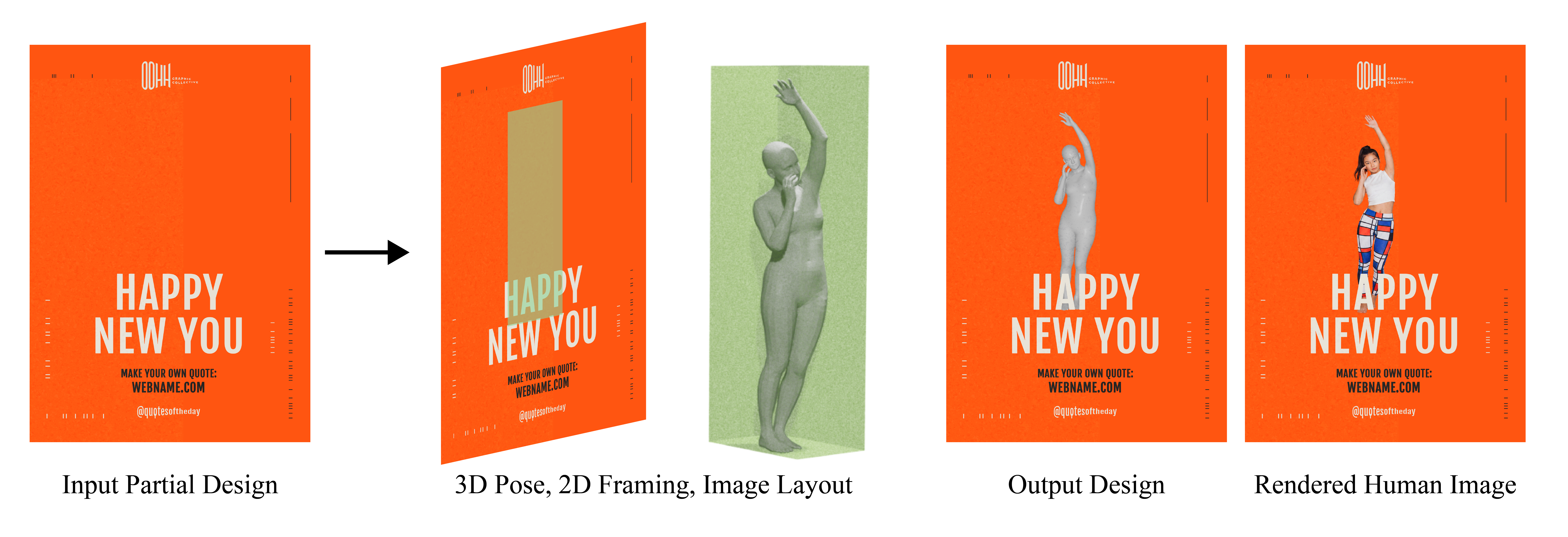
01 / Overview
A human that belongs
in the design.
Pose, framing, and placement shape how we read a graphic design. We make them part of the generation process.
Human images in graphic designs are carefully composed to guide attention and convey a feeling. We introduce design-conditioned 3D human adding: given a partial design with images, text, and vector shapes, generate a 3D human representation that works with the existing elements.
The model jointly predicts the human’s 3D pose, 2D framing, and image layout. The resulting representation can be integrated into the design and rendered as a realistic human image.
Explore the full paper02 / Method
From elements to a complete design.
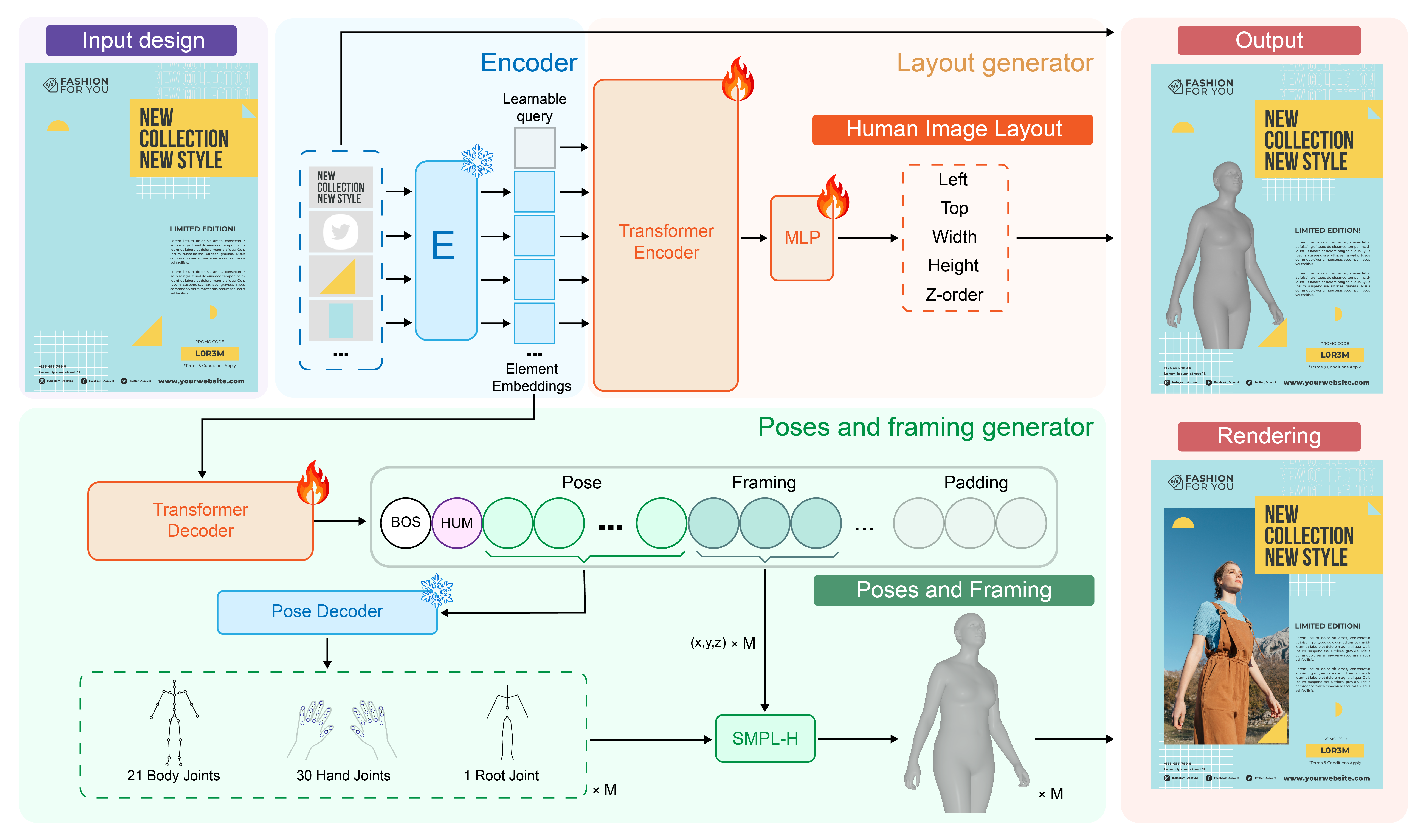
Understand the design
Encode the multimodal elements of a partial design into element-wise representations.
Compose the human
Generate pose and framing tokens, alongside the human image’s bounding box and z-order.
Bring it together
Decode the 3D pose, integrate it into the composition, and render the human image.
03 / Visual results
Designed in context.
Figures from the paper.
Select a figure to view full resolution.
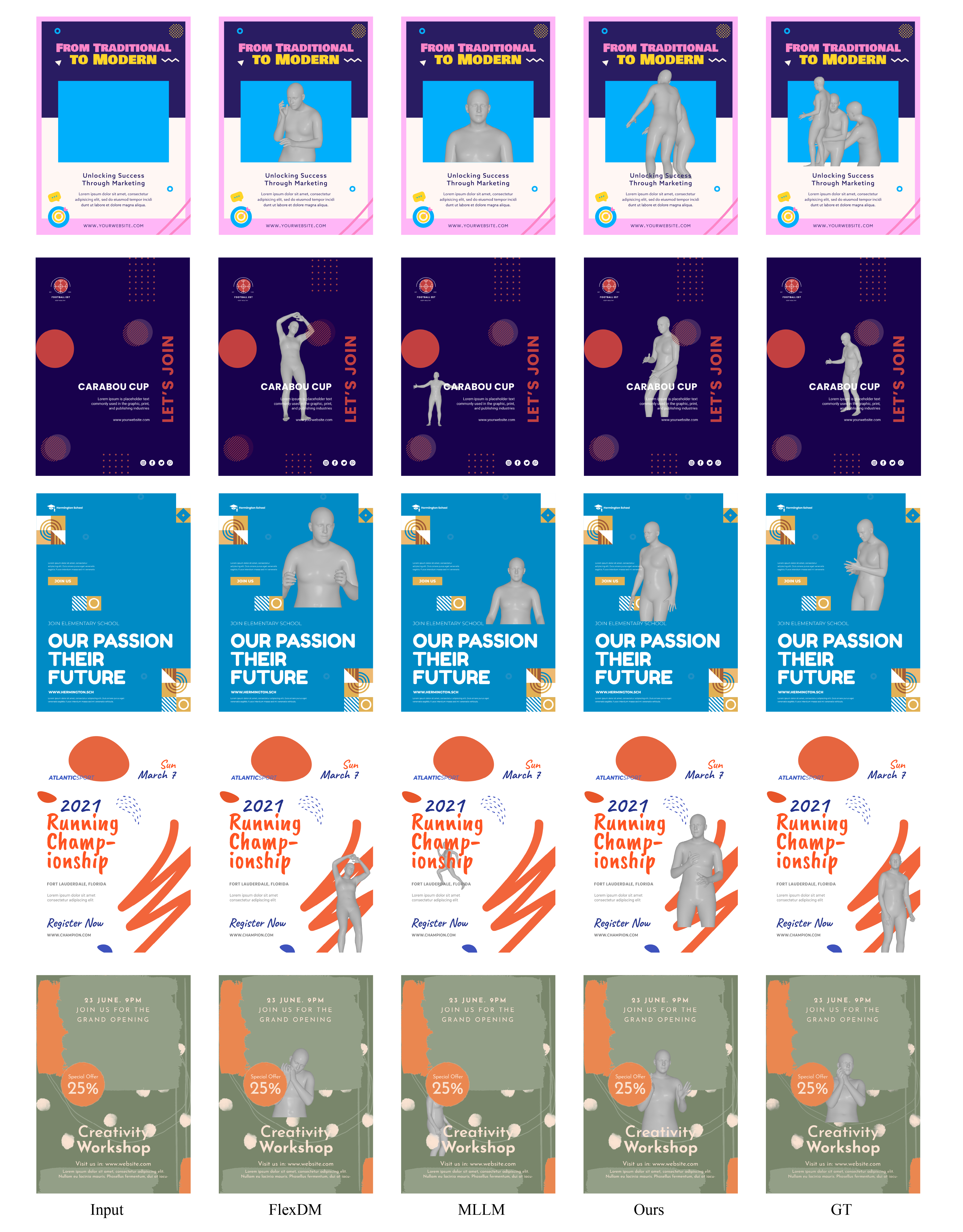
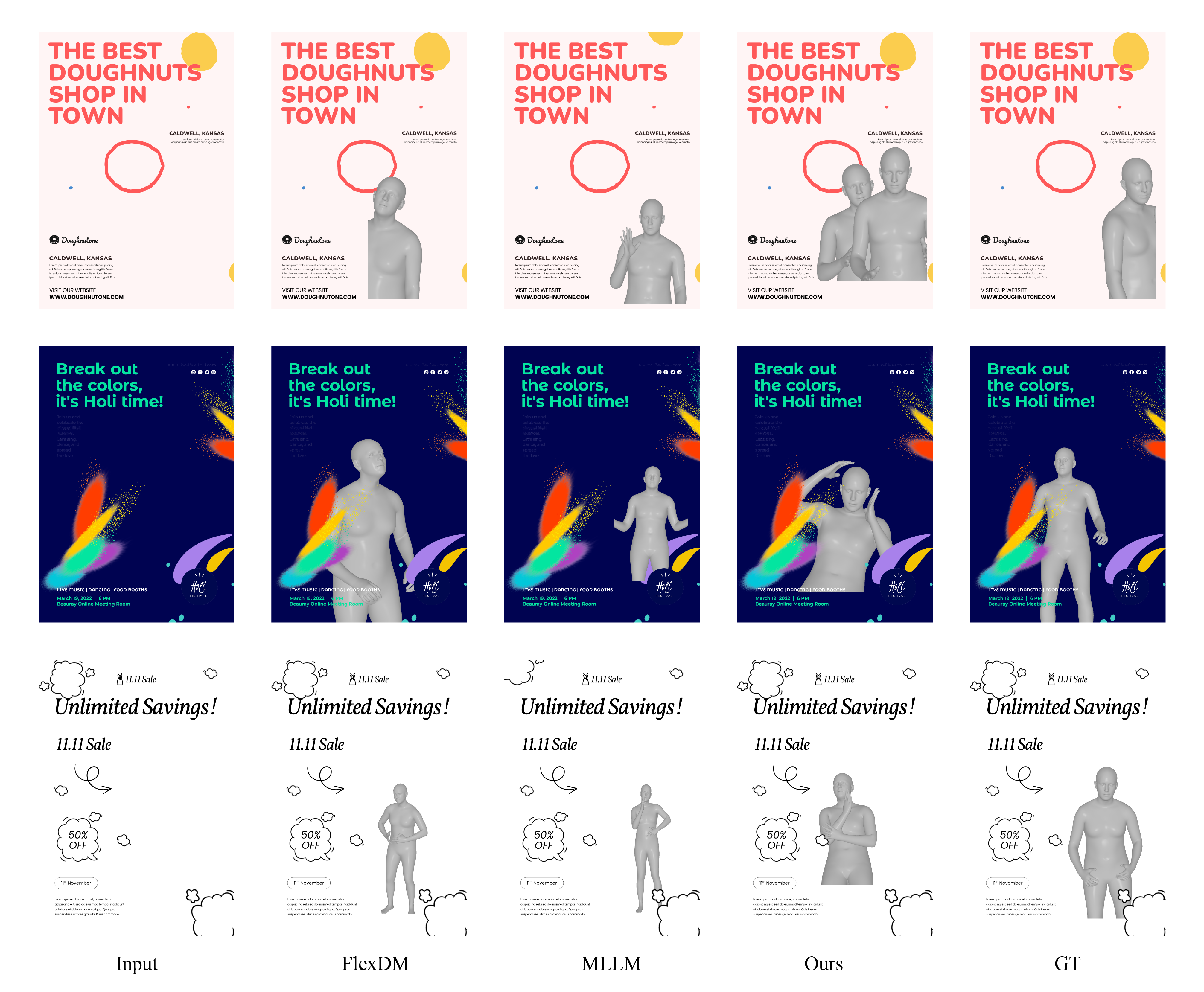
Qualitative comparison of 3D pose, 2D framing, and human-image layout across different methods.
Predicted 3D human representations rendered into realistic human images and integrated with graphic designs.
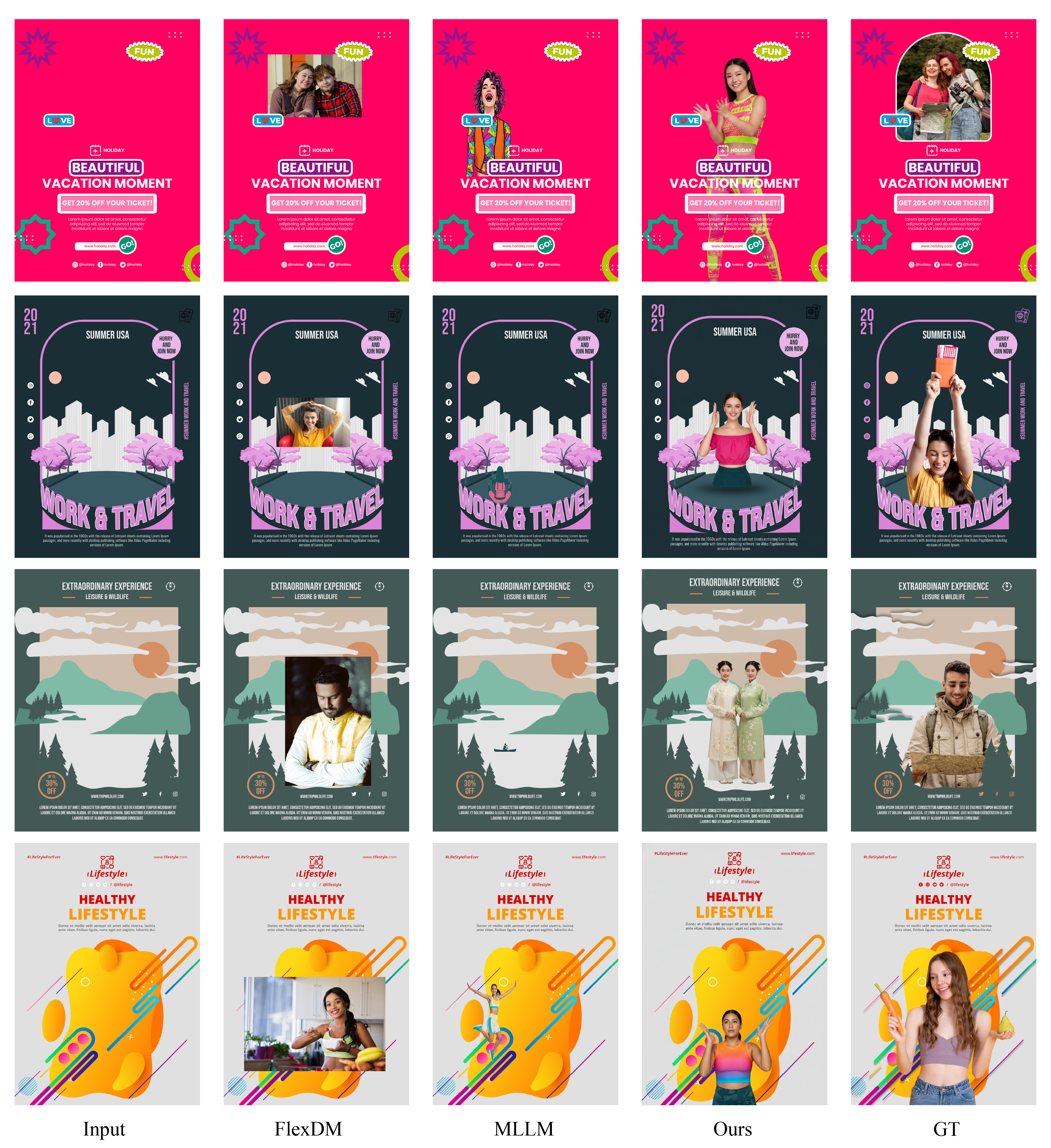
Additional qualitative examples from the paper.
Code release
Try the pipeline.
The repository includes deployment instructions and a small example bundle. The current software release extends the pipeline with a frozen FlexDM design encoder, a Transformer layout encoder, and optional photorealistic rendering.
Qwen Image 2.1 is the default realistic-rendering backend, using the white model for pose and the input design for style. These release extensions are documented separately from the paper method; the figures on this page are the original paper figures.
Installation & examples04 / Citation
Cite this work.
If you find this work useful, please consider citing our paper.
@inproceedings{hou2026humanaware,
  title     = {Human-aware Design Generation: Adding 3D Humans into Graphic Designs},
  author    = {Hou, Zijin and Cao, Ying},
  booktitle = {Proceedings of the 34th ACM International Conference on Multimedia},
  year      = {2026},
  doi       = {10.1145/3767308.3836019}
}